Gonet Academy Students Gain Practical Industrial Safety Exposure at LWSC White Plains Treatment Plant

Gonet Academy Students Gain Practical Industrial Safety Exposure at LWSC White Plains Treatment Plant
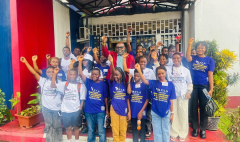
In furtherance of its commitment to practical, industry-centered education, GONET Academy recently facilitated an educational field visit for students enrolled in its Foundation Certificate Professional Program in Occupational Health and Safety Management (OHSM) to the Liberia Water and Sewer Corporation (LWSC) White Plains Water Treatment Center in Harrisburg, Lower Montserrado County.
The educational exercise, conducted recently, provided sixteen OHSM students with firsthand exposure to industrial safety systems, environmental health practices, workplace hazard management, and operational safety procedures within one of Liberia’s most critical public utility facilities.
The initiative forms part of GONET Academy’s broader experiential learning strategy aimed at bridging classroom instruction with real-world occupational health and safety practice while preparing students for the demands of modern industrial and public service work environments.
Before departure, participating students underwent a structured pre-trip orientation focused on professionalism, discipline, teamwork, situational awareness, and workplace safety expectations.
The group departed GONET Academy at approximately 10:35 a.m. and arrived at the LWSC White Plant around 12:25 p.m., where they were formally received by technical personnel and inducted into the facility’s operational and safety environment.
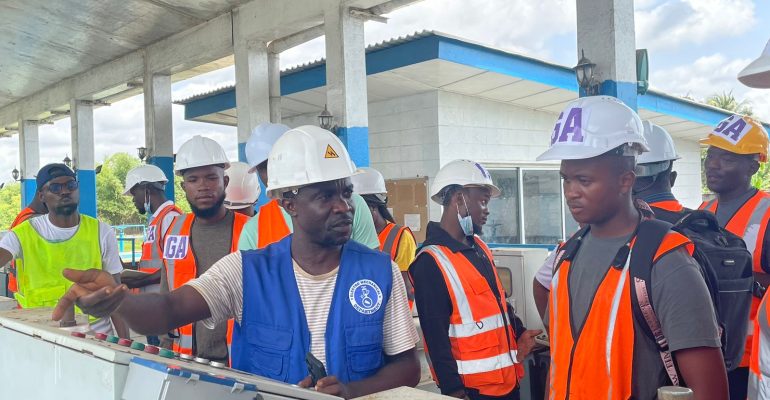
The technical induction and guided safety presentation were led by Mr. Boywins Davis, who provided students with a comprehensive overview of industrial safety procedures and operational protocols governing activities within the treatment facility.
During the induction session, participants were introduced to hazard identification systems, Personal Protective Equipment (PPE) requirements, emergency response procedures and workplace evacuation systems. Others are visitor safety protocols, chemical handling and storage procedures and environmental health monitoring systems.
The session emphasized the importance of integrating occupational safety into all levels of industrial operations and public utility management.
As part of the educational engagement, students received an in-depth historical and operational overview of the White Plant Water Treatment Center.
Officials explained that the facility was originally constructed in 1968, expanded in 1982, and underwent rehabilitation in 2023.
The plant remains one of the country’s principal sources of potable water supply for Greater Monrovia and surrounding communities.
Students learned that the facility primarily sources raw water from the St. Paul River, where seasonal environmental conditions and climate-related salinity changes continue to present operational and treatment challenges.
Through detailed technical presentations, participants were guided through the full water treatment process, including raw water intake, coagulation and flocculation, sedimentation, filtration and pH adjustment. Others are disinfection, laboratory quality testing, and final water distribution.
The discussions highlighted how occupational health and safety practices remain central to ensuring both operational efficiency and public health protection within water treatment systems.
A major focus of the visit centered on chemical hazard awareness and industrial safety compliance.
Students were introduced to several key treatment chemicals utilized during water purification operations, including alum for coagulation, hydrated lime for pH regulation and High-Test Hypochlorite (HTH) for disinfection.
Technical staff explained the occupational risks associated with chemical exposure and stressed the importance of proper chemical storage, risk assessments, PPE compliance, emergency preparedness systems, spill response procedures and workplace communication and signage.
The session provided students with practical insight into how safety management systems are implemented in active industrial environments.
One of the key highlights of the visit was an interactive occupational health and safety engagement between students and technical personnel.
Participants engaged directly with facility experts on issues relating to workplace hazard controls, emergency response coordination, chemical risk mitigation, water contamination prevention, PPE enforcement systems and public health implications of treatment failures.
The discussions further explored the relationship between safe water treatment and disease prevention, with emphasis placed on waterborne illnesses such as typhoid fever, diarrheal diseases, dysentery and other sanitation-related public health threats.
The engagement reinforced the broader occupational safety principle that workplace safety extends beyond employees and directly impacts community wellbeing and national public health outcomes.
At approximately 2:24 p.m., students embarked on a guided technical tour of the White Plant facility.
The tour commenced at the St. Paul River intake point, where participants observed the plant’s raw water source and learned about environmental monitoring and water quality management challenges.
Students later toured various operational sections of the facility, including sedimentation tanks, filtration systems, treatment pools, chemical dosing stations, quality control laboratories and hazard communication areas.
The visit concluded at approximately 4:28 p.m. following lunch and refreshments hosted by the facility.
According to GONET Academy, the field exercise successfully achieved its educational objectives by exposing students to practical occupational health and safety operations within a functioning industrial and public utility setting.
The Academy noted that the experience reinforced a critical industry principle: occupational health and safety is not an isolated administrative function, but a core component of operational performance, environmental protection, institutional sustainability, and community welfare.
Special recognition was extended to Mr. Boywins Davis for facilitating the safety induction, technical presentations, and guided site tour, which provided participants with valuable professional insight into industrial safety management within Liberia’s public utility sector.
The Academy described the initiative as another demonstration of its continued commitment to delivering practical, competency-based, and career-oriented education that equips students with the professional knowledge, technical awareness, and workplace readiness necessary to operate effectively in complex industrial environments.