
Beyond Montserrado: How Gonet Academy Is Breaking Geographic Barriers to Professional Education and Pursuing a Nationwide Vision


Beyond Montserrado: How Gonet Academy Is Breaking Geographic Barriers to Professional Education and Pursuing a Nationwide Vision
From 239 online learners across 13 counties and five foreign countries to a newly developed Virtual Learning Environment integrated into its Gonet Information System, Gonet Academy is advancing a vision of accessible, quality professional education through digital innovation, strategic expansion, and emerging national opportunities.
For a working professional in Maryland County, pursuing professional education in Monrovia can mean more than paying tuition. It may require traveling hundreds of kilometers, securing accommodation, taking time away from work, and managing expenses that make further education difficult to pursue.
For an aspiring entrepreneur in Nimba, a project officer in Lofa, or a young professional in Grand Bassa, the challenge may be similar: the desire to learn exists, but access to suitable training opportunities remains limited.
What if professional education could reach these individuals without requiring them to leave their communities?
What if a learner in southeastern Liberia could participate in a professional development program delivered from Paynesville? What if digital technology could connect learners in Liberia and abroad to the same learning opportunities?
For Gonet Academy, these questions are more than aspirations. They are shaping an institutional journey that is gradually extending professional education beyond the boundaries of its physical campus.
And recent evidence suggests that the journey is already underway.
From One Campus to a Growing Learning Community
Located along S.D. Cooper Road in Paynesville, Gonet Academy has built its professional development model around practical learning, flexible training arrangements, and the belief that access to relevant knowledge and skills can contribute to individual and institutional transformation.
While its physical campus remains an important center for teaching and learning, the Academy has increasingly embraced technology as a means of reducing barriers to participation.
One example is its evening online learning section, which offers structured, live instructor-led professional training via Google Meet on Tuesdays and Wednesdays from 8:00 PM to 9:30 PM.
The arrangement is particularly relevant for working professionals who must balance employment, family responsibilities, and further education.
A recent internal analysis of enrollment records from Cohorts 11–15, implemented between January 2025 and October 2026, highlights the growing significance of this flexible learning model in expanding access to professional education.
Across the five cohorts, 239 learners enrolled in the Academy’s analyzed online section, representing residents of 13 of Liberia’s 15 counties and five countries outside Liberia.
The findings provide an important picture of how flexible learning can help extend professional education beyond conventional geographic boundaries.
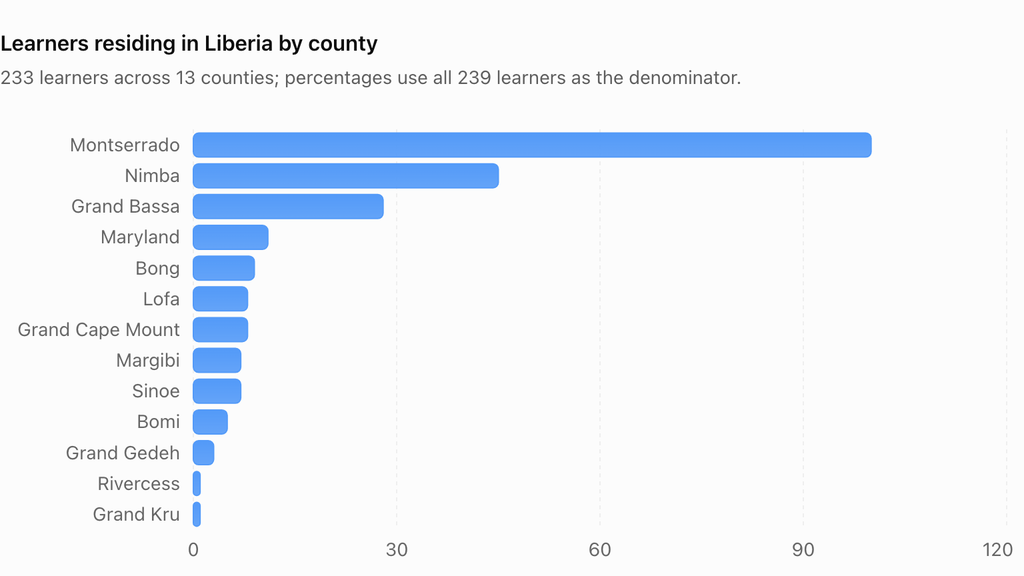
Of the 239 learners, 100 (41.8%) resided in Montserrado County, while 133 (55.6%) lived in the other 12 Liberian counties represented.
Among the counties outside Montserrado, Nimba recorded the highest participation, with 45 learners (18.8% of total enrollment), followed by Grand Bassa with 28 (11.7%), Maryland with 11 (4.6%), Bong with nine (3.8%), and Lofa with eight (3.3%). Additional learners participated from Grand Cape Mount, Margibi, Sinoe, Bomi, Grand Gedeh, Rivercess, and Grand Kru.
The Academy’s online learning community also extended beyond Liberia’s borders, with six participants (2.5%) residing in five foreign countries: Rwanda (2), Guinea (1), Israel (1), China (1), and Cyprus (1).
Altogether, 139 learners, representing 58.2% of the analyzed online enrollment, resided beyond Montserrado County, comprising 133 learners from other Liberian counties and six residing internationally.
These figures tell a story that extends beyond geographic diversity. They demonstrate the growing potential of flexible, technology-enabled professional education to reach individuals who might otherwise face significant barriers to accessing training opportunities concentrated in and around Monrovia.
For Gonet Academy, the significance is clear: a learner’s geographic location should not determine their access to quality professional education.
When the Numbers Begin to Tell a Bigger Story
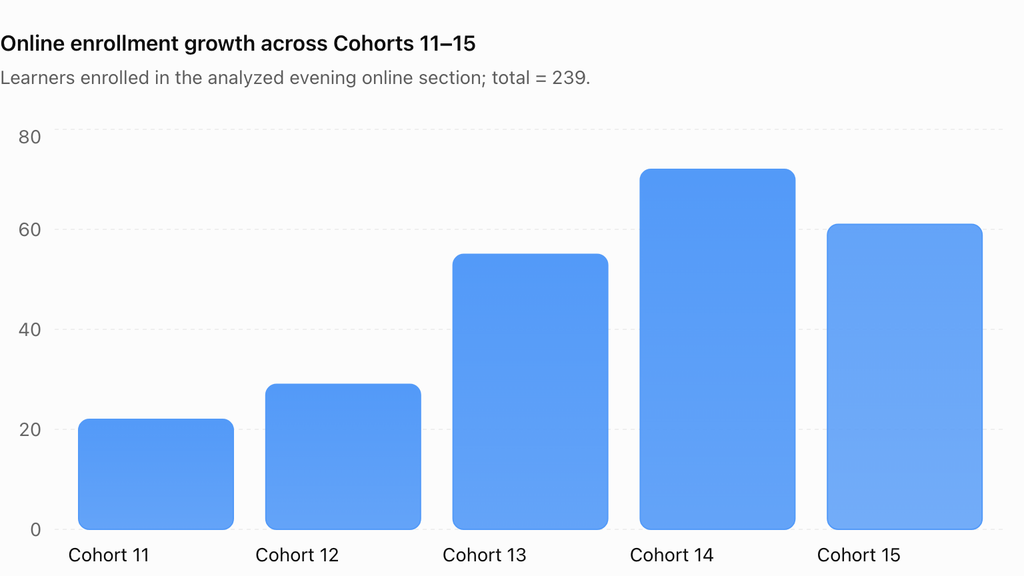
The Academy’s online enrollment did not reach its current scale overnight. Rather, it reflects a gradual expansion in participation across five successive cohorts.
In Cohort 11, the analyzed online section enrolled 22 learners (9.2% of the five-cohort total), representing seven Liberian counties. Enrollment increased to 29 learners (12.1%) in Cohort 12 before rising to 55 (23.0%) in Cohort 13, nearly doubling the previous cohort’s enrollment.
The upward trend continued in Cohort 14, which recorded the highest enrollment of 72 learners (30.1%), representing an increase of 227.3% compared with Cohort 11.
Although Cohort 15 recorded a slight decline to 61 learners (25.5%), participation remained nearly three times the level recorded in Cohort 11, demonstrating the considerable expansion of the Academy’s online learning section over the five-cohort period.
Collectively, these figures reflect growing participation in the Academy’s flexible online learning model, highlighting its potential to expand access to professional education beyond the boundaries of its physical campus.
Geographic representation also expanded considerably over the five-cohort period.
From an initial reach of seven Liberian counties in Cohort 11, the Academy expanded its online learning presence to a peak of 13 counties in Cohort 14, representing 86.7% of Liberia’s 15 counties. Cohort 15 subsequently recorded participation from ten counties, including Maryland, Lofa, and Grand Cape Mount, demonstrating continued engagement among learners beyond Montserrado.
This geographic expansion highlights the growing role of the Academy’s online learning model as more than an alternative to traditional classroom-based instruction. It is becoming an important pathway for extending professional education to learners across Liberia, particularly those who face geographic and logistical barriers to accessing training opportunities concentrated in and around Monrovia.
Equally important is the profile of those participating.
Of the 239 learners, 123 (51.5%) were men and 116 (48.5%) were women, reflecting a nearly equal gender distribution in the Academy’s online learning section.
Of the 207 learners who provided employment information, 134 (64.7%) reported being employed full-time, while 25 (12.1%) were employed part-time. Together, these 159 learners accounted for 76.8% of respondents who disclosed their employment status, highlighting the significant participation of working professionals in the Academy’s online learning section.
This finding reinforces the importance of flexible professional development opportunities that accommodate the realities of working learners.
For many participants, pursuing further education means balancing professional responsibilities, personal commitments, and career aspirations. The Academy’s flexible online learning model provides an opportunity to develop relevant knowledge and skills while continuing to meet these responsibilities.
The distribution of enrollment across program levels and courses provides further insight into the professional development interests of participants.
A Diverse Learning Community: Educational Background and Age
Beyond their professional and institutional affiliations, the educational and age profiles of participants reveal a diverse learning community, bringing together individuals at different stages of their academic and professional journeys.
Among the 207 learners who reported their educational backgrounds, 93 (44.9%) held bachelor’s degrees, making university graduates the largest group. Another 42 (20.3%) reported high school diplomas, while 36 (17.4%) identified as current college students. The remaining participants included 18 associate degree holders (8.7%), 12 master’s degree holders (5.8%), four holders of professional certificates or diplomas (1.9%), and two doctoral degree holders (1.0%).
Notably, 107 learners (51.7% of those reporting) held at least a bachelor’s degree, highlighting the participation of individuals who had already completed substantial formal education but were pursuing additional professional training.
This finding reinforces the importance of continuing professional development as a complement to traditional academic qualifications. It suggests that professional learning is not limited to individuals seeking their first qualification; it also attracts university graduates interested in strengthening practical, career-relevant competencies.
The age distribution provides another important perspective.
Of the 131 learners who reported their ages, the largest group comprised participants aged 25–30 years, accounting for 42 learners (32.1%), followed by those aged 31–35 years, with 34 (26.0%). Together, these two groups represented 76 learners (58.0%), indicating substantial participation among adults in their late twenties and early thirties.
Meanwhile, 19 learners (14.5%) were aged 18–24, another 19 (14.5%) were aged 36–40, and 17 (13.0%) were 41 years or older.
The presence of participants across these age groups demonstrates the relevance of flexible professional learning to individuals at different career stages, from young adults entering the workforce to experienced professionals seeking to strengthen or update their competencies.
For Gonet Academy, these findings reinforce an important principle: professional education is a continuous journey, not an opportunity confined to a particular age, academic qualification, or career stage.
By combining flexible delivery arrangements with practical, industry-relevant programs, the Academy is creating opportunities for learners with diverse educational backgrounds and professional experiences to pursue further development without necessarily interrupting their existing commitments.
Of the 239 learners, 225 (94.1%) enrolled in the Foundation Certificate Program (FCP), while 14 (5.9%) pursued the Professional Diploma Program (PDP). This concentration highlights the particularly strong participation in certificate-level training, suggesting that shorter, foundational professional development programs are an important entry point for learners seeking to strengthen their knowledge and workplace competencies through flexible online learning.
At the course level, Occupational Health and Safety Management recorded the highest enrollment, with 44 learners (18.4% of total enrollment), followed by Project Management with 40 (16.7%) and Procurement, Logistics and Supply Chain Management with 27 (11.3%). Compliance and Risk Management attracted 22 learners (9.2%), while Human Resource Management and Monitoring and Evaluation recorded 19 (7.9%) and 18 (7.5%) learners, respectively.
Together, these six certificate-level courses accounted for 170 learners, representing 71.1% of the total analyzed online enrollment.
The enrollment pattern reflects considerable interest in practical professional competencies associated with workplace safety, project implementation, procurement, organizational management, compliance, and performance monitoring. These are important functional areas across public institutions, private businesses, nonprofit organizations, and development programs.
The strong concentration in certificate-level programs also offers useful insights for the Academy’s future digital learning and geographic expansion strategies. It suggests that accessible, career-relevant foundational training could remain an important component of efforts to reach working professionals and learners in underserved communities.
For Gonet Academy, the emerging lesson extends beyond increasing online enrollment. It is that flexible, practically oriented professional education can create meaningful opportunities for individuals to strengthen their competencies without allowing geographic location or existing professional responsibilities to become unnecessary barriers to learning.
Beyond Geography: Reaching Professionals Across Liberia’s Key Economic Sectors
The Academy’s online learning experience reveals another important dimension of its expanding reach: the professional and institutional backgrounds of the people accessing its programs.
An analysis of the institutional affiliations and occupational profiles of the 239 learners across Cohorts 11–15 identified individuals associated with more than 130 distinct organizations, spanning Liberia’s extractive industries, healthcare system, government institutions, international development organizations, financial services, higher education, and private enterprises.
Importantly, these affiliations reflect the professional backgrounds reported by participants, most of whom enrolled independently to pursue their own professional development. They should not be interpreted as formal institutional sponsorships or corporate training partnerships.
Among the institutions represented in participants’ employment backgrounds were major concession operators, including ArcelorMittal Liberia, Bea Mountain Mining Corporation, Golden Veroleum Liberia, Western Cluster Liberia, and MNG Gold.
These organizations operate across different parts of Liberia, including mining, agricultural, industrial, and concession communities where access to conventional classroom-based professional training may be constrained by distance and work schedules.
The healthcare sector was also represented, with learners reporting affiliations with the Ministry of Health, County Health Teams, regional hospitals, and international health organizations, including Partners In Health and International Medical Corps.
Their occupational backgrounds included nurses, physician assistants, clinical coordinators, laboratory technicians, pharmacists, and other healthcare professionals.
The public sector accounted for another important area of representation. Learners reported employment affiliations with institutions such as the Liberia Revenue Authority, Central Bank of Liberia, National Port Authority, Liberia Immigration Service, Ministry of Finance and Development Planning, and Ministry of Mines and Energy.
Similarly, participants reported professional connections to international and local development organizations, including entities associated with the United Nations system, GiveDirectly, Mercy Corps, BRAC Liberia, Conservation International, and other civil society organizations.
Additional institutional backgrounds extended across commercial banking, universities, telecommunications, logistics, and other private enterprises.
Professionals Learning While Working
The occupational profiles provide further insight into why flexible professional education matters.
Participants included healthcare practitioners, occupational health and safety officers, engineers, technicians, project coordinators, monitoring and evaluation personnel, procurement specialists, logistics officers, administrative professionals, and finance practitioners.
Many of these occupations involve responsibilities that can make conventional training schedules difficult to accommodate, particularly for professionals assigned to regional facilities, industrial operations, healthcare institutions, and field-based development projects.
For a safety officer working at a concession site in Nimba, a healthcare professional serving in Maryland, or a project coordinator stationed in Lofa, traveling regularly to Monrovia for professional training can create significant logistical and financial challenges.
The Academy’s live evening online learning section, delivered through Google Meet on Tuesdays and Wednesdays from 8:00 PM to 9:30 PM, offers an alternative that enables participants to pursue professional development without requiring regular travel to the Academy’s Paynesville campus.
The occupational diversity also helps explain the strong enrollment recorded in courses such as Occupational Health and Safety Management, Project Management, Procurement, Logistics and Supply Chain Management, Compliance and Risk Management, Human Resource Management, and Monitoring and Evaluation.
These programs address competencies relevant to workplace safety, project implementation, organizational governance, operational efficiency, and institutional performance.
For some professionals, such training can strengthen competencies directly related to their existing responsibilities. For others, it may support preparation for broader supervisory, administrative, or management roles.
Although the enrollment records do not establish individual career progression or the motivations behind every course selection, the patterns suggest that flexible professional education is attracting individuals seeking to strengthen competencies relevant to their workplaces and professional aspirations.
The significance of this finding extends beyond the organizations represented.
It demonstrates how individual professionals, even without formal employer sponsorship, are taking steps to invest in their own development.
For Gonet Academy, this reinforces a central lesson: expanding access to professional education is not only about reaching more counties. It is also about making learning opportunities accessible to the professionals who support essential services, industries, institutions, and communities across Liberia.
Beyond Online Classes: Building a Virtual Learning Environment for Quality and Continuous Learning
Expanding access through online classes is an important achievement. However, Gonet Academy recognizes that meaningful digital education requires more than connecting learners and training specialists through a virtual meeting platform.
It requires a structured learning environment where participants can access educational resources, engage with learning activities, receive feedback, complete assessments, and demonstrate the practical competencies they acquire.
This understanding has informed the Academy’s development of its Virtual Learning Environment (VLE), now integrated into the Gonet Information System (GIS), marking a significant step in its institutional digital transformation and academic quality agenda.
Under Strategic Goal 1: Strengthen Program Quality and Learning Outcomes, Gonet Academy’s Strategic Plan 2025–2027 establishes an ambitious objective: to enhance the relevance, rigor, and impact of its academic and professional development programs.
Central to this objective is the integration of learning technologies that support accessible, competency-based, industry-responsive, and learner-centered education.
The Academy’s strategic plan specifically prioritized the introduction of a Learning Management System (LMS) by 2026, providing the technological foundation for more structured blended and online learning delivery.
With the VLE now developed and integrated into the GIS, Gonet Academy has taken a concrete step toward realizing that strategic commitment.
The system brings academic records and learning activities into a unified digital environment, allowing participants to access institutional services and engage with their learning through one integrated platform.
Courses across all three professional training pathways—the Foundation Certificate Program (FCP), Professional Diploma Program (PDP), and Comprehensive Professional Program (CPP)—have been designed and structured within the system.
The Academy is progressively developing and uploading course content across these programs, preparing the platform to support more consistent instructional delivery and learner engagement.
Through the VLE, participants will be able to access course materials, complete quizzes and assignments, undertake practical exercises, participate in structured learning activities, and monitor their academic progress.
For training specialists, the system is intended to support instructional planning, content delivery, assessment management, learner engagement, and progress monitoring.
The integration also represents an important administrative improvement. Rather than treating student records and learning as disconnected processes, the GIS provides a common institutional platform through which participants can manage their academic experience and access learning resources.
Cohort 16: A Major Milestone in Digital Learning Implementation
The Academy’s forthcoming Cohort 16, scheduled to commence on November 16, 2026, will mark an important milestone in the implementation of the VLE.
The cohort will serve as the platform’s major operational pilot, providing an opportunity to introduce the integrated learning environment into actual program delivery, assess its functionality, and identify areas requiring further improvement.
Preparations are already underway.
Cohort 16 participants are undergoing orientation sessions on how to navigate and use the VLE, while training specialists have begun receiving training to strengthen their capacity to deliver instruction and manage learning activities through the system.
These preparations are essential to ensuring that the transition is not simply technological, but also instructional and institutional.
During the pilot, the Academy intends to utilize the VLE for course content delivery, quizzes, assignments, practical exercises, learning activities, and learner progress monitoring.
The experience will also provide opportunities to assess user engagement, system performance, instructional effectiveness, and the support required by both learners and training specialists.
For an institution increasingly reaching participants beyond Montserrado, the development of this integrated platform is particularly significant.
A learner residing in Maryland, Grand Kru, or another county could benefit from structured access to course resources, learning activities, and assessments without depending exclusively on scheduled live instruction.
For working professionals, opportunities for flexible engagement with learning materials can complement evening classes and support more consistent participation.
And for training specialists, the platform offers a framework for delivering learning activities and monitoring progress across different locations.
The Academy’s broader digital learning strategy also emphasizes mobile-friendly and low-bandwidth solutions, recognizing that internet accessibility and connectivity remain important considerations for learners outside major urban centers.
The goal is not simply to move the classroom online. It is to create a learning environment where technology strengthens access, engagement, quality, and measurable learning outcomes.
With the GIS-integrated VLE entering its operational pilot, Gonet Academy is moving from digital learning ambition toward practical implementation.
The next challenge will be ensuring that the system delivers a reliable, inclusive, and meaningful learning experience as adoption expands.
Quality Must Grow Alongside Access
The Academy’s digital learning advancements are supported by a wider set of academic quality priorities under Strategic Goal 1.
These include annual curriculum review and enhancement, standardized student assessment and course evaluation, experiential and project-based learning, faculty development, and competency-based learning outcomes.
Together, these priorities establish an important principle: expanding the number of learners reached must be accompanied by continuous improvement in what learners experience, understand, and can demonstrate.
Under its curriculum enhancement agenda, Gonet Academy seeks to keep programs responsive to national development priorities, emerging workforce trends, industry expectations, and relevant international standards.
Its strategic plan also emphasizes integrating digital literacy, ethics, gender inclusion, and entrepreneurship across disciplines, helping learners develop competencies that extend beyond narrow technical specialization.
Equally important is the Academy’s commitment to practical learning.
Rather than relying exclusively on theoretical instruction, its strategic direction prioritizes case studies, simulations, group projects, real-world problem-solving, field activities, and other experiential learning approaches.
For digital and blended learning, this creates opportunities to combine virtual instruction with structured practical assignments, collaborative activities, and performance-based assessments.
The Academy also intends to strengthen learning outcome monitoring through a centralized Student Learning Outcome Monitoring (SLOM) framework, supported by formative and summative assessments, course evaluations, graduate tracer studies, and feedback mechanisms.
The GIS-integrated VLE provides an important opportunity to support this ambition by facilitating the administration of learning activities, assessments, and learner progress monitoring within a common institutional environment.
Such systems are essential for understanding whether expanded access is translating into meaningful educational outcomes.
The development of training specialists is another important component.
Through its proposed Trainer Performance Enhancement Program (TPEP), the Academy seeks to strengthen instructional planning, learner-centered teaching, assessment design, digital facilitation, and continuous professional improvement.
The ongoing VLE training for Cohort 16 training specialists represents an early practical step toward strengthening institutional capacity for technology-supported teaching and learning.
These priorities are especially relevant to the potential expansion of training delivery beyond Montserrado.
A learner participating from a regional digital hub should benefit from the same commitment to instructional quality, professional relevance, and competency development as a learner attending classes at the Academy’s headquarters.
By 2027, the Academy’s strategic targets include full integration of its LMS and hybrid learning arrangements across departments, annual review of all programs, at least 90% learner satisfaction with teaching and learning quality, and participation of more than 70% of learners in project-based and experiential learning.
These are forward-looking institutional targets that will require continued implementation, monitoring, and investment.
They also demonstrate that Gonet Academy’s digital expansion strategy is not simply about increasing enrollment.
It is about connecting wider access with stronger teaching, more meaningful assessment, practical learning, and evidence of improved professional competencies.
A Strategic Vision That Predates the Opportunity
The Academy’s geographic expansion ambitions are not a recent response to growing online enrollment.
They are embedded in its Strategic Plan 2025–2027, which identifies expanding access and enrollment as a central institutional objective.
Under Strategic Goal 2: Expand Access and Enrollment, the Academy established a specific priority to launch two regional training hubs outside Monrovia.
Nimba and Grand Bassa were identified as potential locations for this expansion.
The proposed hubs would incorporate ICT-enabled classrooms, qualified training specialists, community engagement personnel, and flexible learning schedules, including weekend arrangements designed to accommodate working learners.
The objective is to extend access to practical professional education while maintaining the quality and institutional standards associated with the Academy’s existing programs.
The recent online enrollment findings offer an encouraging connection between this strategic ambition and demonstrated learner interest.
Nimba and Grand Bassa, the two counties identified as potential regional expansion locations, accounted for a combined 73 learners in the analyzed online section.
This does not, by itself, establish the feasibility of opening physical training centers in either county. Further assessments of infrastructure, demand, operating costs, community needs, and delivery arrangements would be necessary.
Nevertheless, the data provides useful evidence to inform future planning.
It demonstrates that the Academy is already reaching learners in these counties through digital delivery, creating a foundation for exploring more accessible and locally supported training arrangements.
The development of the GIS-integrated VLE adds another dimension to this strategic direction.
As the Academy strengthens its capacity to deliver structured learning activities, manage assessments, and monitor learner progress through a unified platform, it is also developing digital infrastructure that could support future regional training arrangements.
For the institution, this is an important principle of strategic growth: expansion should be guided not only by ambition, but also by evidence of where learning opportunities are needed and how people are accessing them.
A Graduation Announcement That Could Open New Doors
On October 31, 2026, Gonet Academy celebrated another major milestone during its Cohort 15 Graduation Ceremony.
Amid the recognition of graduates and their professional achievements, an announcement from the ceremony’s keynote speaker introduced a potentially significant new chapter in the Academy’s expansion journey.
Hon. Atty. Cornelia Wonkerleh Kruah, Minister of Youth and Sports, outlined two opportunities for possible collaboration between the Ministry and Gonet Academy.
The first concerned the Ministry’s initiative to establish digital hubs across Liberia’s fifteen counties in collaboration with the Liberia Telecommunications Authority (LTA).
The Minister invited Gonet Academy to collaborate with the Ministry in delivering professional training programs through the proposed hubs.
For an institution whose strategic plan already prioritizes regional expansion and ICT-enabled learning, the announcement represented a particularly relevant opportunity.
A partnership of this nature could potentially allow Gonet Academy to extend training delivery through shared digital infrastructure, rather than relying exclusively on establishing and operating independent facilities in every location.
Such an approach could help connect national digital inclusion initiatives with structured professional and technical training.
The development of Gonet Academy’s GIS-integrated VLE also creates a potentially valuable connection between the Academy’s internal digital learning infrastructure and the Ministry’s proposed county-level digital hubs.
If suitable arrangements are established, the Academy could explore how its digital learning platform might support course delivery, learner engagement, assessment, and progress monitoring for participants accessing training through shared facilities in different counties.
The second opportunity concerned the Ministry’s scholarship program.
During her remarks, the Minister indicated that Gonet Academy would be considered for participation in the scholarship initiative alongside public universities.
If formalized, such an arrangement could create another avenue for expanding access to professional education, particularly for eligible individuals who face financial barriers to training.
The Minister also designated the Deputy Minister responsible for Technical and Vocational Education and Training (TVET), Hon. Laraamand S. Nyonton, to coordinate further engagement with Gonet Academy.
Both opportunities remain subject to consultations, institutional assessments, applicable requirements, and formal agreements.
However, the announcements establish a promising basis for discussions on how public-sector initiatives and institutional training capacity might complement one another.
Connecting Digital Infrastructure with Practical Skills Development
The potential collaboration raises a question central to Liberia’s human capital development agenda:
How can expanding digital infrastructure translate into meaningful opportunities for people to acquire relevant knowledge and practical skills?
Digital hubs can provide important infrastructure for connectivity and technology-enabled activities. But the broader value of such facilities also depends on how they are used, who can access them, and what learning opportunities become available through them.
This is where collaboration between government institutions and qualified training providers can become important.
Gonet Academy’s existing online learning experience offers a starting point for exploring structured training delivery through shared digital facilities.
Its certificate and diploma programs cover areas relevant to workforce development, including digital productivity, project management, monitoring and evaluation, entrepreneurship, human resource management, procurement, and occupational health and safety.
Depending on the infrastructure, learner needs, and institutional arrangements, selected programs could potentially be adapted for delivery through county-level digital hubs.
The GIS-integrated VLE could further support such a model by providing a common digital learning environment through which training specialists and learners access course resources, undertake assignments and assessments, and monitor learning progress.
This would be particularly valuable in a distributed training arrangement, where learners may participate from different counties while following consistent curricula, assessment requirements, and institutional quality standards.
The Academy’s Cohort 16 VLE pilot will therefore offer an important opportunity to generate practical lessons about digital learning implementation, user readiness, instructional support, and system improvement.
These lessons could inform future decisions about expanding digital learning delivery to additional communities.
Such an approach would require attention to facilitator availability, connectivity, learner support, assessment procedures, quality assurance, scheduling, and the practical components of individual courses.
It would also require coordination to ensure that any expansion preserves the Academy’s training standards and complies with applicable regulatory requirements.
The opportunity is therefore not simply about extending the number of places where training can be offered.
It is about exploring how digital infrastructure, professional education, learning technologies, and institutional collaboration can work together to reduce barriers to learning without compromising educational quality.
From Strategic Planning to Evidence-Based Expansion
For Gonet Academy’s Founder and Chief Executive Officer, Mohammed Kerkulah, the convergence of online enrollment results, strategic expansion priorities, digital learning innovation, and emerging government collaboration opportunities reinforces a long-standing institutional conviction.
“Our campus may be in Paynesville, but our vision has never been limited to Paynesville,” Kerkulah said.
He emphasized that the Academy’s ambition is not simply to increase enrollment or establish additional facilities, but to make relevant professional education more accessible to people who might otherwise face significant barriers to participation.
“When we developed our Strategic Plan 2025–2027, we identified regional expansion as a priority because we understood that the need for professional development extends far beyond Monrovia. Today, our online learning data is showing us that this demand is real, and that technology can help us respond to it.”
For Kerkulah, the Academy’s experience also illustrates the importance of combining institutional ambition with measurable evidence.
“We must not measure institutional growth only by the number of buildings we establish or the number of people we enroll. We must also ask how many barriers we are removing, how many communities we are reaching, and how effectively our programs are helping people develop the competencies they need.”
He described the Minister’s announcements as encouraging opportunities to explore collaboration that could accelerate the Academy’s existing strategic priorities.
“No single institution can address all of Liberia’s skills development challenges. But when government, training institutions, industry, and other partners bring their strengths together, we can create opportunities that would be difficult to achieve independently.”
The Academy intends to pursue formal engagement with the Ministry of Youth and Sports to clarify the proposed collaboration, explore possible training delivery arrangements, and better understand the requirements for potential participation in the scholarship program.
Beyond Enrollment: The Responsibility to Deliver Quality
While the Academy’s online learning results demonstrate encouraging geographic reach, its leadership recognizes that expanding access must be accompanied by a sustained commitment to educational quality.
Reaching learners across multiple counties is an important achievement, but enrollment alone does not establish whether learners have successfully completed their programs or achieved meaningful professional outcomes.
Future expansion will therefore require continued attention to learner engagement, training quality, assessment, completion, and the practical application of acquired competencies.
This is where the Academy’s two strategic goals become mutually reinforcing.
Strategic Goal 2 focuses on reaching more learners. Strategic Goal 1 focuses on strengthening the quality and outcomes of the learning they receive.
The GIS-integrated VLE provides an important practical connection between these objectives.
By bringing learning activities, assessments, learner progress monitoring, and institutional records into one digital environment, the Academy is developing a stronger foundation for managing and supporting the learning experience across different locations.
The forthcoming Cohort 16 pilot will provide an opportunity to test these capabilities, gather feedback from learners and training specialists, and identify improvements needed before wider adoption.
The Academy’s institutional approach emphasizes that professional education should extend beyond the award of certificates and diplomas.
It should equip participants with relevant knowledge, strengthen their ability to perform effectively, and support their contributions to organizations, businesses, and communities.
This principle will be particularly important as the Academy considers how to adapt training programs to new delivery environments.
The objective must remain consistent whether a participant attends a classroom in Paynesville, joins an evening online section from Nimba, or eventually participates through a county digital hub.
Access creates the opportunity to learn. Quality helps ensure that the opportunity has lasting value.
A Vision Larger Than One Campus
From 22 learners in its Cohort 11 online section to 239 enrollments across five cohorts, Gonet Academy’s digital learning experience offers an encouraging example of how institutional innovation can begin to address geographic barriers to professional education.
Its reach across 13 Liberian counties and five foreign countries demonstrates the possibilities of flexible learning, while also revealing the need for continued investment in infrastructure, access, and learner support.
The Academy’s development of a Virtual Learning Environment integrated into its Gonet Information System represents another important milestone.
With courses structured across the Foundation Certificate, Professional Diploma, and Comprehensive Professional Programs, content development underway, and learners and training specialists preparing for its use, the Academy is approaching a new phase of technology-supported professional education.
The commencement of Cohort 16 on November 16, 2026, will mark the beginning of a major operational pilot, bringing course content, learning activities, assessments, and learner progress monitoring into an integrated digital environment.
This development connects directly with the Academy’s commitment to strengthening learning outcomes while expanding access.
The Ministry of Youth and Sports’ proposed county digital hubs and potential scholarship collaboration could provide additional pathways for pursuing these objectives.
For Gonet Academy, the next phase will involve translating digital learning investments and encouraging public-sector announcements into effective implementation, structured institutional engagement, feasibility assessment, and practical expansion planning.
The journey will require resources, coordination, regulatory compliance, institutional learning, and sustained commitment.
But the direction is clear.
An institution established to equip, empower, and elevate professionals is increasingly translating its vision into practical steps that extend beyond the boundaries of its physical campus.
And as Liberia continues to pursue digital inclusion, workforce development, and opportunities for young people, the question becomes increasingly important:
What if the next generation of skilled professionals could access meaningful learning opportunities without having to leave the communities they call home?
Because the future of professional education should not be limited by geography. And the potential of Liberians extends across all fifteen counties.
Gonet Academy — Equip. Empower. Elevate.
About Gonet Academy
Gonet Academy is a professional development and technical and vocational education and training institution based in Paynesville, Liberia. Operating under GonetAfrica, Inc., the Academy provides practical, career-relevant certificate, diploma, and comprehensive professional training programs designed to strengthen individual competencies and institutional capacity.
Through classroom-based, hybrid, and eligible online learning pathways, Gonet Academy seeks to expand access to professional education and support lifelong learning, workforce development, and organizational effectiveness.
Guided by its Strategic Plan 2025–2027, the Academy is advancing initiatives in curriculum quality, competency-based instruction, experiential learning, digital learning technologies, and regional training access.
Its newly developed Virtual Learning Environment, integrated into the Gonet Information System, is scheduled to enter a major operational pilot with Cohort 16 beginning November 16, 2026. The platform is designed to bring institutional records and learning activities together, supporting course delivery, assessments, practical learning, and learner progress monitoring.
Data note: The online learning figures presented in this article are based on an internal analysis of 239 enrollment records in the Tuesday/Wednesday evening online section across Cohorts 11–15. Six learners originally recorded under Liberian counties (five under Montserrado and one under Maryland) were reclassified according to their actual countries of residence. The revised distribution comprises 233 learners residing in Liberia and six residing internationally. Of the 239 learners, 100 (41.8%) resided in Montserrado, 133 (55.6%) in the other 12 Liberian counties represented, and six (2.5%) in five foreign countries. These figures do not represent all Academy enrollment or all online delivery arrangements. Employment percentages are calculated from the 207 learners who provided employment information. Enrollment and geographic reach do not, by themselves, establish training completion or professional outcomes.