GonetAfrica Challenges Young Leaders to Turn Small Actions into Lasting Change

GonetAfrica Challenges Young Leaders to Turn Small Actions into Lasting Change
—As Alphia Faith Kemokai Urges Graduates to be “Problems Solvers”
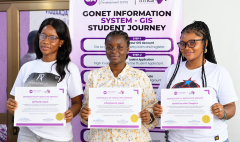
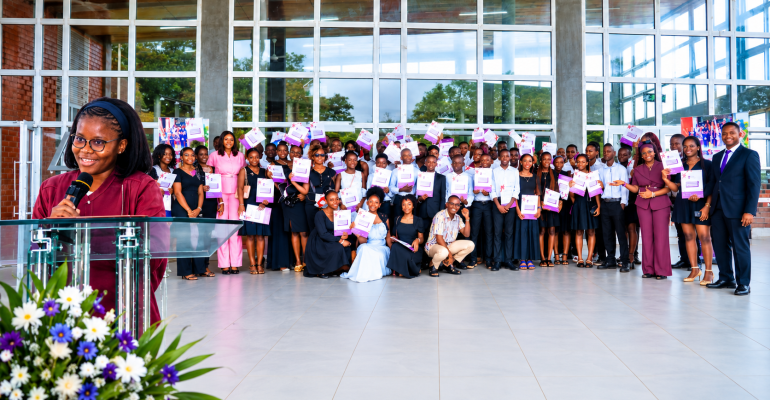
GonetAfrica has graduated 60 young people from its 2026 Youth Empowerment & Leadership Vacation Program, challenging the emerging leaders to move beyond acquiring knowledge and become problem solvers, responsible citizens and agents of positive change in their communities.
The graduation ceremony, held on September 3, 2026, at the Liberia Learning Center in Paynesville, marked the conclusion of a seven-week youth development initiative conducted under the theme “Speak. Lead. Influence.” The program brought together graduates, parents and guardians, facilitators, GonetAfrica staff and invited guests to celebrate a learning experience designed to strengthen communication, public speaking, English-language proficiency, confidence and leadership skills.
At the ceremony, guest speaker Alphia Faith Kemokai delivered perhaps the ceremony’s most memorable message that leadership does not necessarily begin with extraordinary resources or positions of authority, but taking on personal responsibility.
Kemokai used the well-known story of a burning forest, and a hummingbird used the story of a burning forest and a small hummingbird to illustrate the power of individual responsibility—demonstrating how seemingly small individual actions can contribute to solving even the most overwhelming problems.
According to the story, as a forest burned, the animals watched helplessly while a small hummingbird repeatedly flew to a nearby creek, carried drops of water in its beak and returned to the fire. Although its contribution was tiny compared with the scale of the blaze, the bird refused to remain a spectator.
Its contribution was insignificant compared with the enormous blaze, but the little bird continued its effort rather than becoming a spectator.
For Kemokai, the lesson was direct—the size of an individual’s contribution does not determine its value.
She used the story as a challenge to the young graduates—do something, while challenging the them to adopt the hummingbird’s mindset by identifying problems in their communities and taking whatever constructive action they can to address them.
Her message transformed the graduation from a celebration of certificates into a call to responsibility.
The young graduates, she emphasized, should not wait until they possess great wealth, influential positions or extraordinary resources before contributing to society. Leadership can begin with a small initiative, a responsible decision, a useful idea or simply the courage to speak when something needs to be changed.
Her message was particularly significant in the context of Liberia, where young people frequently encounter social, economic and institutional challenges that can appear too large for individual intervention. The hummingbird analogy reframed leadership as a willingness to take responsibility rather than waiting for someone else to solve a problem.
She urged the graduates to identify problems around them and take initiatives capable of producing meaningful change, regardless of how small their initial contribution might appear.
As aspiring leaders, the graduates were also encouraged to discover their voices and understand their individual purposes in life—not simply for personal advancement, but for the betterment of society.
The message reinforces the central philosophy of the vacation program—communication and leadership skills have greater value when they are translated into responsible action.
From Training to Purpose
GonetAfrica Chief Empowerment Officer Mohammed Kerkulah congratulated the graduates and urged them to put their newly acquired knowledge and skills into practice.
That challenge is central to the sustainability of any youth leadership program. Training can improve confidence and communication, but its deeper value emerges when participants apply those skills in their schools, families, communities and future workplaces.
The graduation, therefore, represents a transition rather than a conclusion.
The graduates leave with the expectation that they will communicate with greater confidence, lead with greater responsibility and use their influence constructively.
The ceremony also featured reflections from parents and guardians, remarks, certificate presentations and special awards recognizing outstanding participants.
The 2026 program forms part of GonetAfrica’s broader effort to use vacation periods as an opportunity for young people to acquire practical skills beyond the conventional school curriculum.
Rather than treating the vacation solely as a period away from formal education, the initiative has sought to turn it into a period of structured learning, personal development and leadership formation. The 2026 edition, which ran from July 15 to August 28, was designed for young people between the ages of 10 and 19 and placed particular emphasis on communication and leadership.
That approach reflects an important reality in youth development: academic achievement alone does not necessarily equip young people to communicate ideas confidently, work with others, identify community problems or take initiative.
The program’s focus on speaking, leadership and influence therefore seeks to bridge the gap between learning and application—preparing participants not only to know, but also to express, lead and act.
Awards included Most Improved Participant, Leadership Excellence, Best Participant in Class, Best Writer, Best Debater, Best Reader and Best Public Speaker.
These distinctions recognized more than academic performance. They celebrated improvement, discipline, participation, creativity, teamwork, communication and the willingness to grow.
The emphasis on communication is particularly significant for young Liberians preparing for an increasingly competitive society.
The ability to articulate ideas, speak publicly, listen, debate respectfully and influence others can affect opportunities in education, employment, entrepreneurship, civic engagement and leadership.
But the program’s deeper objective appears to be connecting communication skills with character and purpose.
A confident young person who lacks a sense of responsibility can use influence destructively. Conversely, a young person who combines confidence with integrity, empathy and purpose can become a powerful contributor to community development.
That distinction was reflected in the message delivered to the graduates—speak with purpose, lead with character and use influence to lift others.
The graduation ceremony, for the parents and guardians, represented the completion of an educational experience outside conventional classroom learning, while for the GonetAfrica family, it represented an investment in young people whose skills and attitudes could contribute to the future of the country.
Yet the real measure of the program will come after the certificates are put away.
The hummingbird story offers the answer expected of them.
Liberia’s problems are more than the burning forest—too extensive for one person to solve. But waiting for someone else to act can allow the fire to spread.
The graduates have therefore been challenged to begin where they are, with what they have. Their contribution may initially appear small. But if multiplied by 60 young people—and eventually by hundreds or thousands more—the small drops can become a movement for change.
The message from the graduation was consequently larger than celebrating 60 young leaders. It was a challenge to develop 60 young problem solvers.