
Gov’t Endorses Gonet Academy as Catalyst for Human Capital Transformation

Gov’t Endorses Gonet Academy as Catalyst for Human Capital Transformation
—Education Minister says Kerkulah’s COVID-era vision has grown into a national movement for workforce readiness and youth empowerment
At a time when Liberia continues to grapple with unemployment, weak institutional capacity, and a widening skills gap among its youthful population, the government has offered rare and emphatic validation to a non-state actor it says is making a “critical and excellent” contribution to national human capital development.
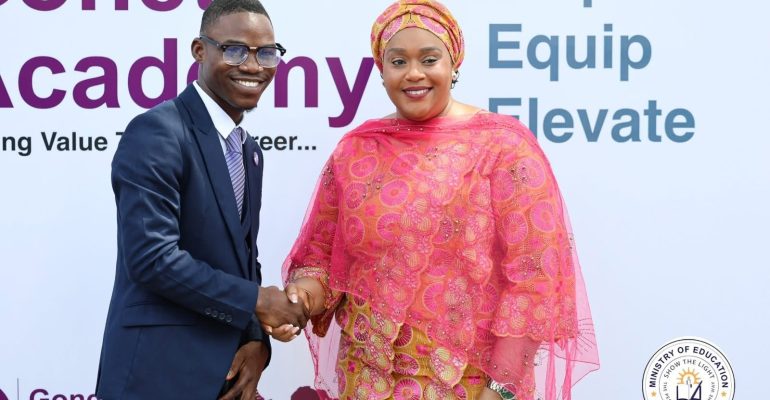
That endorsement came from none other than the Minister of Education, Dr. Jarso Maley Jallah, who used the graduation ceremony of Gonet Academy’s Cohort 13 not only to address graduates, but to situate the Academy—and its founder, Mohammed Kerkulah—within Liberia’s broader development narrative.
“Today, the Government of Liberia recognizes you,” Dr. Jallah declared, turning directly to Kerkulah. “Gonet’s story, as I listen, is one of vision and faith in action.”
Gonet Academy’s story, as the Minister recounted, began not in a moment of prosperity but in crisis. In early 2021, as Liberia and the world reeled from the social and economic shock of the COVID-19 pandemic, confidence was low, opportunities were shrinking, and thousands of young people were disconnected from both jobs and hope.
It was in that bleak moment that Kerkulah introduced what the minister described as a “movement.”
“If you think of when he spoke about starting this program,” she said, “it was during COVID—where hope was lost, where the global community was on its knees. But he stood strong.”
According to Kerkulah, the idea behind GonetAfrica and its training arms—Gonet Academy and the Africa Youth Leadership Academy (AYLA)—was simple but ambitious: to close the gap between formal education and the skills, discipline, and ethical leadership Liberia urgently needs.
“With one laptop, a small rented space, and a big dream,” Kerkulah told the audience, “we made a commitment to empower people, strengthen institutions, and contribute meaningfully to Liberia’s social and economic development.”
Five years later, that commitment has matured into a nationally recognized institution, training thousands of Liberians across all 15 counties.
Government Validation: Leadership Must Be Prepared
For the Minister of Education, the relevance of Gonet Academy lies in its alignment with a hard national truth—leadership in Liberia can no longer be improvised.
“Liberia is at a moment where leadership can no longer be bestowed, improvised, or assumed,” Dr. Jallah warned. “It must be prepared.”
She argued that while Liberia has made progress in expanding access to education, enrollment figures alone are not enough.
“National progress is not measured by enrollment alone,” she said. “It’s measured by what learning produces—competence, judgment, productivity, institutions that work, and public trust that holds.”
That, she stressed, is where institutions like Gonet Academy matter.
“They answer the questions formal schooling alone cannot,” the Minister said. “Who understands systems? Who can manage complexity, uncertainty, and public trust? Who can translate knowledge into service?”
A Growing National Footprint
The numbers behind Gonet Academy’s work help explain the government’s praise.
Over the past five years, more than 5,000 youth and professionals have been trained in employable, leadership, and market-relevant skills, over 4,000 graduates, the majority women, have completed structured programs, more than 900 professionals graduated in Cohort 13 alone, and over 500 institutions have been supported through training and capacity-building engagements.
Cohort 13 itself reflects the Academy’s emphasis on inclusion and workforce relevance—913 graduates, 56 percent women, drawn from foundation certificates, professional programs, and diploma tracks.
Dr. Jallah singled out the gender balance as particularly significant.
“To the 513 women in this cohort,” she said, “your presence here is a deliberate and necessary correction of the leadership pipeline.”
Beyond statistics, the Minister framed Gonet’s impact in moral and institutional terms. She warned graduates—and the wider society—that skills without integrity can be dangerous.
“Knowledge without integrity is dangerous,” she cautioned. “Skills without accountability are just expensive mistakes.”
Her message echoed Gonet Academy’s own values of excellence, integrity, accountability, and transformation—principles Kerkulah said were deliberately embedded from the institution’s founding.
At a time when public trust in institutions remains fragile, the Minister argued that Liberia’s recovery depends on professionals who refuse shortcuts, resist corruption, and quietly improve systems from within.
“These acts may go unnoticed by the world,” she said, “but they are the stones we are using to build Liberia’s future.”
Perhaps the strongest signal of validation came when Dr. Jallah publicly committed the Ministry of Education to working with Gonet Academy.
“Our commitment as the Ministry of Education,” she said, “is that you have a partner and a friend in us as we work together to transform Liberia’s human capital.”
For Kerkulah, that endorsement represents a full circle moment—from a pandemic-era idea to a nationally acknowledged movement.
“Five years ago, this was a dream,” he reflected. “Today, it is an institution. And in the years ahead, it will be a legacy.”
As the ceremony concluded, both government and academy leaders alluded to a movement, not a moment, emphasizing that Cohort 13 was not an endpoint.
“You are not just students anymore,” Dr. Jallah told graduates. “You are on the pipeline. This is a movement. It does not stop here—it begins here.”
In a country hungry not just for jobs, but for ethical, capable leadership, the government’s validation of Gonet Academy underscores a broader shift–recognition that Liberia’s future will be built not by policy alone, but by prepared people.
And in that effort, the Minister made clear, Gonet Academy has become an indispensable part of the national equation.