Blog

5 Essential Skills Every Monitoring & Evaluation (M&E) Professional Should Learn

IMG-20260804-WA0000
Career Insights News and Updates

5 Essential Skills Every Monitoring & Evaluation (M&E) Professional Should Learn

Career Insights

5 Essential Skills Every Monitoring & Evaluation Professional Should Learn

Monitoring and Evaluation has evolved beyond simply collecting data and writing reports. Today’s professionals are expected to generate evidence that improves performance, strengthens accountability and supports informed decision-making.

Whether you are a student, an aspiring M&E officer or an experienced practitioner, developing the right skills is essential for long-term professional success.

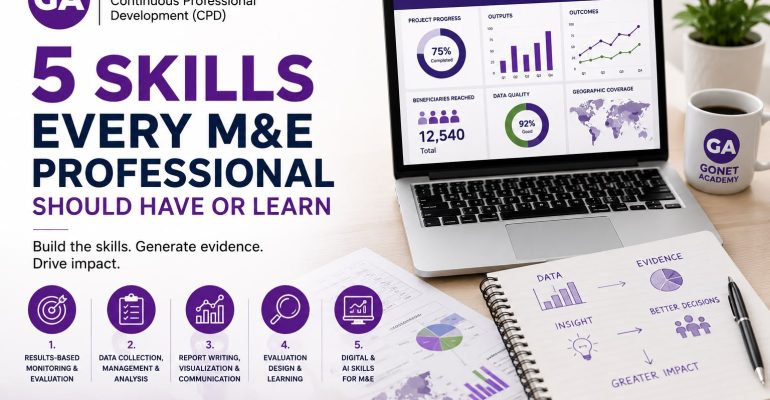
The following are five essential competencies that every Monitoring and Evaluation professional should learn and continuously strengthen.

01
Essential Skill One

Results-Based Monitoring & Evaluation

A strong foundation in Results-Based Monitoring and Evaluation is the cornerstone of effective M&E practice. Professionals must understand how programmes are designed to achieve results and how those results can be measured.

  • Develop logical frameworks and theories of change.
  • Design M&E frameworks and performance measurement plans.
  • Develop clear and measurable SMART indicators.
  • Establish baselines, targets and milestones.
  • Track project outputs, outcomes and long-term impact.
Without a clear understanding of results-based management, it becomes difficult to demonstrate whether a project is achieving its intended objectives.
02
Essential Skill Two

Data Collection, Management and Analysis

Good decisions depend on quality data. M&E professionals must know how to collect, organise, manage, analyse and interpret data accurately.

  • Design surveys, questionnaires and interview guides.
  • Conduct Key Informant Interviews and Focus Group Discussions.
  • Use observation checklists and document reviews.
  • Apply suitable sampling methods and techniques.
  • Clean, validate and manage collected data.
  • Perform quantitative and qualitative data analysis.

Knowledge of tools such as Microsoft Excel, SPSS, Power BI, KoboToolbox, ODK and Google Forms can significantly enhance an M&E professional’s effectiveness.

03
Essential Skill Three

Report Writing, Data Visualization and Communication

Collecting data is only valuable when the findings can be communicated clearly and translated into information that people can understand and use.

  • Write concise and evidence-based reports.
  • Present findings to technical and non-technical audiences.
  • Develop informative dashboards and visualizations.
  • Use charts, graphs and infographics effectively.
  • Translate evidence into practical recommendations.
Organizations value professionals who can transform complex data into clear and compelling stories that influence decision-making.
04
Essential Skill Four

Evaluation Design and Organizational Learning

Monitoring tracks progress, while evaluation helps explain why expected results were or were not achieved. Effective professionals must understand the different approaches used to evaluate programmes.

  • Process evaluations.
  • Outcome evaluations.
  • Impact evaluations.
  • Baseline, midterm and endline assessments.
  • Learning and adaptive programme management.
  • Evaluation criteria and quality standards.

Evaluation criteria may include relevance, effectiveness, efficiency, impact, coherence and sustainability.

Strong evaluation skills enable organizations to improve future programming, strengthen learning and maximize development impact.
05
Essential Skill Five

Digital and Artificial Intelligence Skills for M&E

Technology is transforming the Monitoring and Evaluation profession. Modern practitioners are increasingly expected to use digital tools and artificial intelligence to improve efficiency, data quality and decision-making.

  • Mobile data collection platforms.
  • Dashboard design and development.
  • Geographic Information Systems basics.
  • AI-assisted data analysis.
  • Automated reporting systems.
  • Data quality assurance tools.
  • Data analytics and visualization software.
Professionals who embrace technology can spend less time completing repetitive manual tasks and more time generating meaningful insights.

Final Thoughts

Technical knowledge alone is no longer enough to succeed in Monitoring and Evaluation. The most effective M&E professionals combine analytical thinking, data management, communication, evaluation expertise and digital skills to provide evidence that drives better decisions and stronger development outcomes.

As organizations increasingly prioritize accountability, learning and measurable results, investing in these five skills will position you as a valuable professional capable of designing robust M&E systems, generating credible evidence and supporting impactful programmes.

Continuous learning is the hallmark of every successful M&E professional. The more you strengthen these competencies, the greater your ability to contribute to sustainable development and organizational success.